Saturday, March 24, 2012

Post #5: Is There a Right Answer to the Question: "Should We Legalize Marijuana?"


After spending the last couple of weeks exploring and researching the affects that legalizing marijuana could have on the American economy, I have come to the conclusion that the revenue raised by the medical marijuana dispensaries does benefit the counties where they are located. However I am still concerned that there is not enough regulation when it comes to people driving under the influence of marijuana. Because the issue is so young I have not found a definitive answer to the prospective revenue that is possible if we were to legalize marijuana. Although there are several states that have legalized medical marijuana throughout the nation I believe that until the federal laws are reformed no real benefit will be recognized for our nation. When I started my research I was absolutely against marijuana being legalized whether it be medicinal or recreational. I now believe that legalizing marijuana for medicinal purposes could be beneficial not only for the patients who need it but for our suffering economy as well. I also discovered that the general consensus is that Americans are in favor of some form of reform to the existing drug laws but because of the stigma that has been placed on marijuana by the government people are afraid to legalize it.

As I continue with my research for my next paper I am not sure what thesis I will argue. I still want to research how the state government plans to determine impairment limits. I still wonder how they plan to allocate the revenue? Also, I wonder how realistic is it for us to expect something that has been illegal for so long to become accepted by society as legal? In my last post I discussed the issues that have risen regarding the driving while “high” issue and the possibility of a dispensary having to have a pharmacist on duty at all times. These issues could possibly keep the voters from passing the bill in November. If some of the big issues had more definitive answers society might be more accepting. In this article that I was introduced to on NPR.org by Eyder Peralta, televangelist Pat Robertson argues the benefit of decriminalizing marijuana. I thought it was a nice way to sum up the biggest argument that all of my sources seem to have: that the Federal Government is throwing away an obscene amount of revenue as long as marijuana remains illegal. Whether it is through the criminal court spending or through the lack of regulated dispensaries. I look forward to continuing my research for the next assignment. This has proven to be a more complex issue than I had imagined.


Image from:

Wednesday, March 21, 2012

Post #4: Should the laws that apply to alcohol apply to marijuana?


            In my last blog post, I explored the federal law issues regarding medical marijuana. Since then, I decided I needed more information about the national opinion on the legalization of medical marijuana and so I searched for answers by looking for news articles that spoke about how other states are dealing with legalizing medical marijuana. This led me to a source in the Associated Press that is from the library website. The author, Kristen Wyatt, discusses that if marijuana is made legal how are we going to prosecute drivers that are under the influence of marijuana. Since the THC stays in the system for up to thirty days, determining how impaired a driver is will be virtually impossible. This makes me wonder how are they going to evaluate if a suspected driver is high? Also, I question whether impairment limits will be able to be set since blood and urine test are the most accurate ways to determine intoxication and neither of these can be performed at the time a suspect is stopped by a police officer.
                       
                                                          
            After reading this source by Wyatt, I found another article by Anne M. Amato, which was published in the Connecticut Post. This source takes a different stance from the first one, because the author discusses the best way for states to dispense medical marijuana. Questions that arise for me reading this source include: how can we regulate and control the growers of marijuana? Should it be a requirement for dispensaries to have a licensed pharmacist on staff? Should we cut out the dispensaries and only allow medical marijuana to be sold just like any other controlled substance, in a pharmacy? How would this affect the states ability to tax medical marijuana?

            When I compare these two sources by Wyatt and Amato to the articles I researched last time in the Denver Post and the Durango Herald, I find that despite arguments that emphasize the benefits of legalizing marijuana there are just as many drawbacks. Among all these ideas, I most believe that the revenue that could be generated is a benefit for us all, but also I still doubt that having it so accessible to anyone over the age of 21 is a good idea.

 Amato, Anne M.. "Medical pot in the pipeline." Connecticut Post (Bridgeport, CT) 20 Mar. 2012, News: NewsBank. Web. 21 Mar. 2012.

Associated Press, KRISTEN WYATT. "Standards remain elusive for those 'driving while high' - Issue arises as two states prepare to vote on legalizing marijuana.." St. Louis Post-Dispatch (MO) 19 Mar. 2012, Third Edition, News: A15. NewsBank. Web. 21 Mar. 2012.


Image from:
http://goamusic.files.wordpress.com/2011/08/medical-marijuana-preview.jpg 

Monday, March 19, 2012

Post #3: Will the Federal Government Shut Down a State Regulated Industry?


My second post talked about the prospect of marijuana becoming legal in Colorado and the proposal of the 17 states that have pending legislation to legalize marijuana. As I continue my research I find that the problem remains with the Federal Governments laws regarding marijuana. After reading an article from the Denver Post, titled "Out of Touch on Colorado Pot Policy" that I found on the library website discussing the opinion of Barbara Roach which is the new head of the Denver division of the U.S. Drug Enforcement Administration regarding federal law vs. state law: it is clear that not all Coloradoans are happy about the legalization of medical marijuana. Roach claims “people are not taking into account what can happen to those who are growing it. There are homes with mold and water damage in the hundreds of thousands and there are children in there, too.” After reading this source, I am confused about this argument that Roach discusses. If this is Roach’s main point is she the best person for this job? Will she waste money that the state does not have fighting what seems to be a loosing battle against medical marijuana? She also told Felisa Cardona of the Denver Post that she is going to live in a city that does not allow dispensaries. Why would she have taken the job in a state that has medical marijuana if she is so adamant about opposing it? This makes me wonder if she understands how the medical marijuana laws in Colorado actually work. Does she know that just because there is no dispensary in her city that does not mean there is no marijuana?

Image Courtesy of www.amconmag.com 

            After reading the article by the Denver Post, I also read an article in The Durango Herald that is from the library website. This source takes a different stance from the first one, because the articles discusses  the federal governments misinformed views on medical marijuana. The second article reports the benefit that the state has had from the sale of medical marijuana. It states that the Colorado Department of Revenue claims that state sales tax revenue has doubled in one year. It also reports that Colorado Springs is getting about $60,000 a month in taxes from medical marijuana alone. Can the protestors of medical marijuana continue to deny the benefits that the regulation and taxation could bring? The article also discusses the fact that the cities that have banned dispensaries may realize the considerable revenue loss they are experiencing. This makes me wonder if these cities will eventually vote to change the ban on dispensaries? The dispensaries are not able to use banking services because banks in Colorado refuse to do business with them out of fear that the federal government will cut federal banking insurance. The threat of racketeering charges by the U.S. Attorney General is also a deterrent. If these are cash only businesses how can we accurately tax them? This also brings about the question of: should the Federal Government begin studying the states that have legalized marijuana to determine the possible revenue that it could generate?

             When I compare these two sources from the Denver Post and the Durango Herald to the articles that I researched in my last post from the Coloradoan.com and the Valley Advocate, I find that despite a large amount of the population in favor of drug reform that it seems to me that until the Federal Government changes their laws on marijuana the states are always going to be in jeopardy of prosecution by the U.S. Attorney General. Regardless of the benefits that individual states have with the legalization of marijuana the fact is they are breaking the law. What would the implications be if the Federal Government shuts down a state regulated industry? When I reflect back on all of these ideas, I agree most with the benefit that regulation of marijuana could bring to our cities, but I still doubt that we are any closer to the Federal Governments consideration to reforming its laws. Comparing these sources in the Denver Post  and the Durango Herald they are similar in comparing dispensaries stating that a regulated dispensary is much better for a neighborhood than a liquor store and explains that prescription drugs are not usually taxed but patients are happy that they do not have to go get their medication in an alley. I agree with these sources because alcohol is just as bad a marijuana and nobody seems to have an issue with having a liquor store on every corner. However I am still not sure that we should legalize marijuana at all. 

Cardona, Felisa. "Out of touch on Colo. pot policy." Denver Post, The (CO) 8 Mar. 2012, OPINION: 8B. NewsBank. Web. 19 Mar. 2012.

Haug, Jim. "Medical pot tax a boon?." Durango Herald, The (CO) 18 Mar. 2012, Local & Regional: NewsBank. Web. 19 Mar. 2012.
Image from:
http://agent3155.com/wp-content/uploads/2011/06/medical-marijuana-patients.jpg 

Wednesday, March 7, 2012

Post #2: Marijuana Prohibition…Will it End?


Further exploration let me to read a short article on the Coloradoan.com regarding the marijuana use bill on the November ballot. This bill will allow voters to decide if Colorado will make marijuana legal for recreational use. If passed it would become legal for adults 21 and older to use marijuana with no doctor prescription. It would also be legal to possess one ounce of pot OR six plants. The plan would also allow commercial pot sales. The state would be able to place an undetermined excise tax on the marijuana and the proceeds would go to education. While this “plan” sounds great there is no elected official supporting the plan? I wander how it is possible to ensure that only persons 21 years and older will have access to marijuana? I also wander what laws will have to be revised regarding driving while under the influence? I doubt that even if the bill passes in Colorado that the federal government will ignore those openly breaking the law. Can we really legalize pot if there is no federal law supporting it?

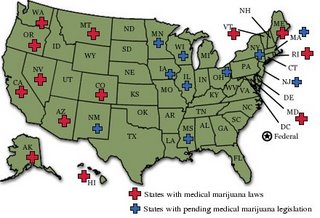
            After reading the article on the Coloradoan.com I read an article by Maureen Turner in the Valley Advocate that I found online in the library database that is published in Massachusetts confirming that 17 states have pending legislation to legalize medical marijuana and that 16 states have already passed the medical use of marijuana. These sources are similar in that they are both advocating the legalization of marijuana. All of these states mentioned in the Valley Advocate benefit from the taxes they are collecting from the sale of pot. Proceeds are allocated differently per state, but it is hard to argue the fact that it does produce a lot of revenue and it cuts down on spending in the judicial system. Dick Evans drafted the bill in Massachusetts to legalize marijuana. He does not expect it to pass but hopes that it will open the door for reform of drug laws. In turn opening the door for increased revenue for the state. He argues that passing such laws will create jobs. It will also decrease local and federal spending on criminal prosecution. This makes me wander if we should continue to spend billions of dollars to prosecute "petty" offenders for marijuana? Will this money that is saved on criminal prosecution be put toward helping our public education system or other much needed government funded programs?


When I compare these articles on the Coloradoan.com and the Valley Advocate I find that many people in the United States are in favor of some reform regarding marijuana. Both sources argue that marijuana should be taxed and regulated like alcohol. Amongst these ideas, I most believe that we do need some reform but doubt that it is possible to regulate it like we do alcohol. Further comparison shows that both sources support at minimum having marijuana decriminalized or possibly made legal altogether. I believe that if it is legal in your state and you have a doctors prescription you should not be punished but do not think that there is a strong enough plan in place to regulate pot yet.

            The more I research the marijuana issue the more I realize how divided we all are on this issue as a nation. It seems that we are divided into the people that are totally against it and the people that are tired of fighting it. Are we as a nation becoming complacent when it comes to marijuana? Is the medical marijuana industry making it easier to accept completely legalizing it? What would the reaction of the Federal Government be if all of the states rally together to make marijuana legal? Will they conform and pass federal regulation laws? Or will they continue ignoring the public outcry for change?

Turner, Maureen. "Pot Tolerance - Is legalization of marijuana on the horizon for Massachusetts?." Valley Advocate (Easthampton, MA) 9 Mar. 2012, News & Commentary: NewsBank. Web. 15 Mar. 2012


Image from:
http://www.eqgroup.com/images/medical-marijuana-laws-746134.jpg 

Friday, March 2, 2012

Post #1: Marijuana and the Economy


How would the legalization of marijuana affect the American Economy? Could we tax it as we do alcohol or tobacco? Who would decide how the revenue would be allocated? Would it be possible to keep people from continuing to sell it on the “black market” for their personal gain? Being from Texas I never imagined that this would be something that would ever become a real issue. Living that close to the border of Mexico and knowing of the “war on drugs” that our government has declared, this seemed to be a very far-fetched idea. I have lived in Colorado for two and half years and have seen the dispensaries that were opened and closed in that short of a time. I do realize that this was medical marijuana but that is one step closer to the realization that the legalization of marijuana could actually become a reality.

I have a very divided view on this. Both sides of the argument have relevance. Part of me feels that the money spent by the Federal Government to fight the illegal import and consumption of marijuana could be used to fund programs and initiatives that would strengthen our economy. These programs could fund much needed medical research, public education, homeless prevention, childhood obesity and many more. I think that the taxes collected from the marijuana could be used to help the poor and lower middle class with their housing and basic financial needs. The other side of this argument is that I feel it would be too readily available to children. I feel that it would be like alcohol and become very socially accepted. If we made this “drug” legal could it lead to the legalization of others?


To answer these questions I will need to research government and private economic studies, government publications and any national and local newspaper articles on the subject. I realize that there are many other issues to consider. How would we regulate it? How would it affect the health of Americans? What political issues would be raised? However, for this blog I will only be exploring the economic effects on America.

Image from:
http://www.agreenercountry.com/wp-content/uploads/2009/08/washington-state-medical-marijuana.gif 

Monday, February 27, 2012

Lynnette Lichner

Hello all, my name is Lynnette and this is my blog. My hobbies are cooking and hanging out with my family. I am studying to be an elementary school teacher.
This was a fun blog. elementary teacher blog